A press brake and a panel bender can both put a clean flange on a sheet metal blank, but they get there in very different ways. The right choice depends on part size, gauge, bend count and how many parts you need.
That choice is part of everyday sheet metal forming and bending work for our Grand Rapids, MI metal fabrication company.
Here's how the two machines compare.
How a Press Brake Bends a Part
A drives a punch on a moving ram into a matching die, folding the blank along a straight line. The operator positions the part against a backgauge for each bend and flips or turns it between hits.
That flexibility makes press brakes the workhorse of most fab shops, handling heavier material, narrow parts and odd shapes.
How a Panel Bender Works
A panel bender clamps the blank flat and moves a pair of bending blades up or down around the bend line. that the machine references and manipulates the part on its own, so the operator mainly loads blanks.
Because the part is referenced only once, bend-to-bend dimensions do not stack the way they can on a brake.
Parts That Suit a Panel Bender
Enclosures, cabinet sides, doors and flat panels are the classic fit. The same article puts panel bender capacity at about 0.020 to 0.125 inches of steel, so thin and mid-gauge sheet is the sweet spot.
Panel benders also form short flanges and hems with universal tooling, features that often need special tooling on a brake. That is one reason they show up on custom metal enclosures and electrical boxes.
When a Press Brake Is the Better Call
Thicker plate, narrow channels and bends that face the center of a panel usually belong on a press brake. Bending blades cannot reach an internal flange surrounded by material.
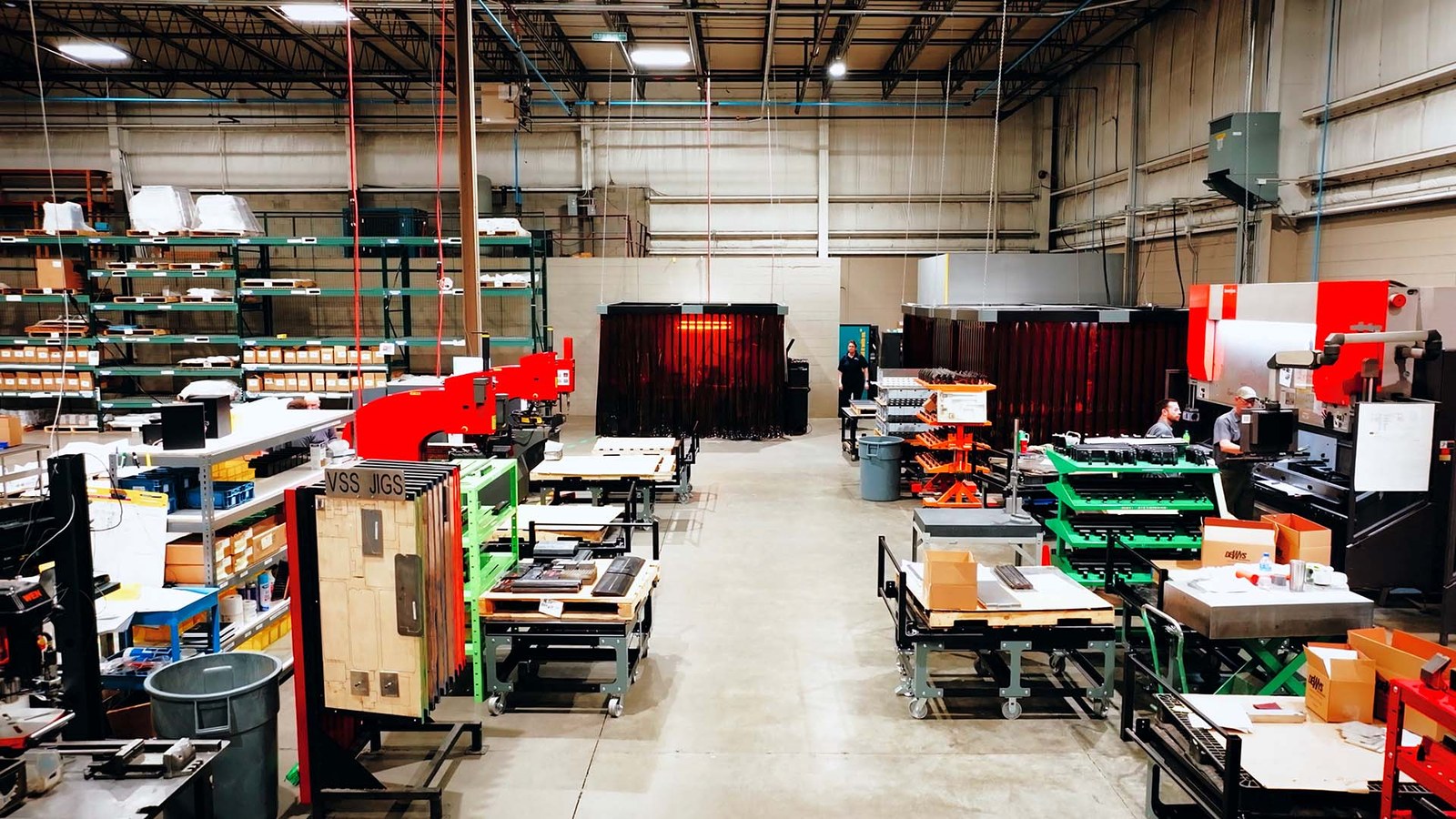
Our shop runs Bystronic Xpert 80, 150 and 200 press brakes alongside two Amada ATC HG 1003 brakes with automatic tool change. That range covers parts a panel bender cannot.
Setup Time and Batch Size
Setup is where the two machines differ most. a typical press brake setup of 15 to 30 minutes, while a panel bender changeover can take about five minutes manually.
Shorter changeovers make small, mixed batches practical without building extra inventory. Automatic tool change press brakes close part of that gap.
What This Means for Your Part Design
A few design choices steer the decision. Short flanges, hems and many perimeter bends lean toward panel bending, while internal bends and heavy gauge lean toward the brake.
Flange lengths and bend angles still need realistic sheet metal tolerances on the print. An early design for manufacturability review is the best time to ask which process your part will run on.
The Equipment Behind Each Bend
DeWys bends parts on a Salvagnini Performer P-2 panel bender as well as its press brake fleet. Bending sits alongside cutting, welding, finishing and assembly in our full list of metal fabrication services.
With both under one roof, each part goes to the machine that runs it best.
Frequently Asked Questions
Can a panel bender handle prototypes and small runs?
Yes, a panel bender can make sense even for one-off or short runs because changeovers are quick and the tooling is universal. DeWys has no minimum order quantity and often builds prototypes with design for manufacturability feedback.
The Fabricator notes that a panel bender should be considered even for very limited runs that may never repeat. Quotes can include tiered quantities so you can compare pricing.
Which metals does DeWys bend and form?
DeWys bends 5052 and 3003 aluminum, annealed alloy steel, cold rolled and hot rolled low carbon steel, mild steel, high strength steel, and 304, 430 and 316 stainless steel. Gauge and length vary by part.
Stainless grades are common for medical and food equipment, where corrosion resistance matters. Material choice also affects how much a bend springs back.
What is an automatic tool change press brake?
An automatic tool change press brake loads and swaps its own punches and dies, so the operator does not set up tooling by hand between jobs. DeWys runs two Amada ATC press brakes with AMNC 3i control.
Those machines include an integrated bend sensor that helps keep bend angles consistent from part to part. Automated setups also make variable lot sizes easier to schedule.
Can one part use both a panel bender and a press brake?
Yes, some parts start on a panel bender for the perimeter flanges and finish on a press brake for bends the blades cannot reach. A frame with flanges around an internal window is a common example.
The Fabricator describes a 20-gauge frame where the four internal bends had to move to the press brake. Splitting the work lets each machine do what it does best.
How long does a formed sheet metal part take to produce?
Typical production lead time at DeWys is four to six weeks, depending on the complexity of the part or assembly. The team works with customers to shorten prototype and production lead times where possible.
Bending is only one step, so cutting, welding, powder coating and assembly also shape the schedule. Clear prints and complete quote requests keep the job moving.
Partner With DeWys Metal Solutions
Choosing between a panel bender vs press brake comes down to the part, and our team makes that call with you before production starts. Our Grand Rapids, MI sheet metal fabricator team is glad to look over your next bent part.
Call DeWys Metal Solutions today at (616) 677-5281 or request a quote online.